
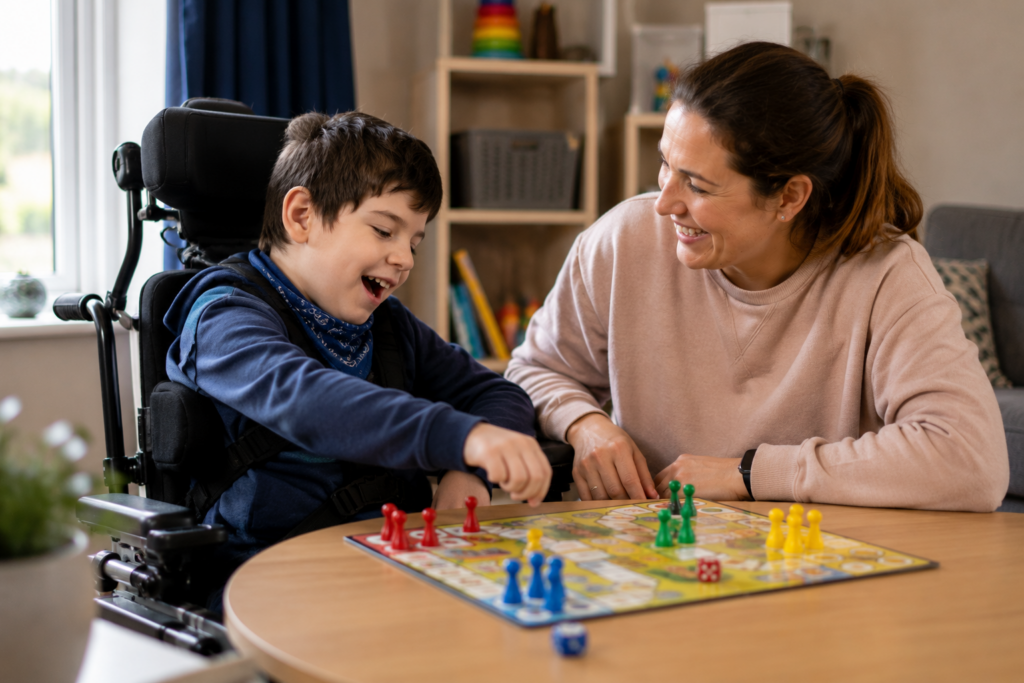
Finding the best toys and games for kids with limited mobility isn’t about searching for one perfect “accessible toy”. It’s about finding ways for a child to explore, create, laugh and play with as much independence as possible.
Every disabled child is different. A toy that works brilliantly for one child may be frustrating for another. Movement, grip, reach, positioning, fatigue, vision, communication and sensory preferences can all influence how enjoyable and accessible an activity feels.
The best starting point is therefore simple: look at what your child enjoys and find a way of making that play accessible to them.
Start With the Child, Not the Toy
Play is important for children’s development and can support imagination, independence, sensory skills, communication and social skills.
But accessible play shouldn’t feel like therapy disguised as fun.
Your child might love music, superheroes, messy play, animals, puzzles, technology or simply making everyone laugh. Begin with those interests and then consider what might make participation easier.
Think about whether your child can comfortably:
- Reach the toy.
- Hold or manipulate its pieces.
- Activate buttons or switches.
- See or hear its features.
- Play from their usual sitting or lying position.
- Join siblings and friends using it.
Sometimes the solution is a specialist toy. Other times, a simple adjustment to an ordinary toy is enough.
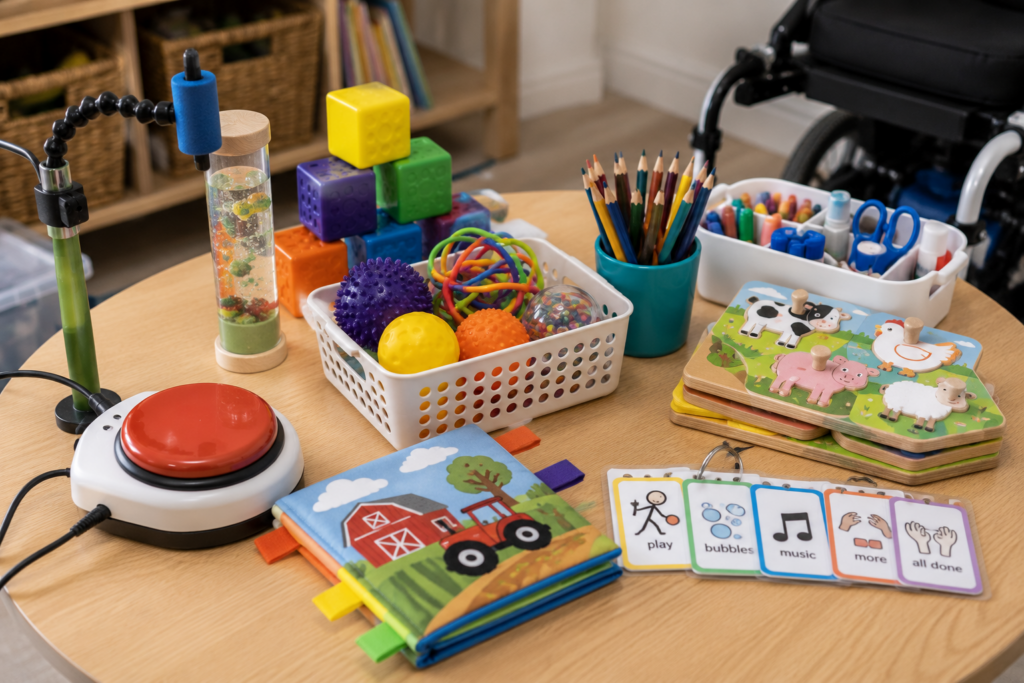
1. Switch-Adapted Toys
For children who find small buttons, levers or controls difficult to operate, switch-accessible toys can open up opportunities for more independent play.
A large external switch can activate a compatible or specially adapted toy with a movement that’s manageable for the child. Depending on their needs and equipment, this might involve a hand, foot, head or another reliable movement.
Switch-accessible options can include toys that move, light up, play music or perform an action.
The important part isn’t the technology itself. It’s the cause-and-effect experience of “I did that”, which can make play more engaging and give children greater control.
For personalised equipment or more complex adaptations, an occupational therapist or another professional who knows your child may be able to advise. Scope also recommends considering precisely which part of an activity is difficult before choosing assistive equipment.
2. Sensory Toys
Sensory play can be particularly accessible because it doesn’t always depend on precise movement.
Depending on your child’s preferences, possibilities include:
- Textured balls and fabrics.
- Light-up toys.
- Musical instruments.
- Shakers and bells.
- Sensory bottles.
- Water play.
- Bubbles.
- Play dough or other mouldable materials.
Look for experiences your child actively enjoys rather than assuming that every “sensory” product will suit them.
Some children seek bright lights, sounds and textures; others can find the same experiences overwhelming. Follow your child’s cues and preferences.
3. Arts and Crafts
Creative activities can often be adapted without changing what makes them fun.
Chunky crayons, easy-grip brushes, stamps and large pieces of paper can reduce the need for precise hand movements. Paper can also be secured to a surface using tape, a clipboard or reusable adhesive.
Contact specifically suggests options such as magnetic boards, clipboards and angled work surfaces to make activities easier for some children with movement differences.
Don’t worry about creating a perfect finished picture. Finger painting, choosing colours, directing an adult where to draw or making marks using an adapted tool are all valid ways to create.
4. Building and Magnetic Toys
Traditional construction toys with tiny pieces can require considerable grip and fine motor control.
Larger building pieces may be easier to pick up, position and separate. Magnetic construction toys can also require less force to connect pieces, although suitability depends on the child’s abilities and age.
For a child who cannot physically place pieces themselves, collaborative building can work beautifully.
Ask:
“Where should this one go?”
The child becomes the designer while a parent, sibling or friend acts as their hands.
That is still active participation—and it can turn building into a wonderfully social game.
5. Board and Card Games
Family games don’t need to be abandoned because rolling dice, moving counters or holding cards is difficult.
Instead, change how the game is played.
Someone else can move a counter according to the child’s instructions. A dice roller or digital dice app may replace physical dice. Cards can be placed in a holder or arranged where they’re easy to see.
Choose games with simple actions, larger pieces and flexible rules whenever possible.
The objective isn’t to make a child perform every physical action independently. It’s to ensure they can make choices, influence the game and share the fun.
6. Accessible Digital Games
Tablets, phones and video games can offer another form of accessible play.
Accessibility varies significantly between games and systems, so look for settings such as remappable controls, adjustable difficulty, touch controls, alternative input options and other accessibility features appropriate to your child.
Adapted technology can make an enormous difference, but cost and setup can also create barriers. Scope’s research into accessible gaming found affordability, setup and availability of adapted technology among the challenges reported by disabled gamers.
Before investing in expensive equipment, check compatibility carefully and, where possible, explore whether you can try or borrow it first.
Adapt the Play, Not Just the Toy
One of the most useful ideas for parents is that accessible play doesn’t always require specialist toys.
An everyday toy might become much easier to enjoy by:
- Raising it to wheelchair-tray height.
- Securing it so it doesn’t slide away.
- Using larger handles or grips.
- Putting pieces within comfortable reach.
- Allowing extra time for responses.
- Letting another person carry out movements chosen by the child.
- Changing the rules of a family game.
The same principle applies beyond the home. Inclusive play spaces can include wheelchair-accessible equipment, sensory panels, supportive swings, ramped play frames and accessible sand or musical areas.
Accessibility isn’t about making everyone play in exactly the same way. It’s about making sure everyone gets to participate.
How to Choose the Right Toy
Before spending money on specialist equipment, ask a few practical questions.
What does my child enjoy? Interest should come before developmental goals.
How will they activate it? Consider reach, strength, grip and positioning.
Can it grow with them? Toys offering different ways to play may remain useful for longer.
Can siblings or friends join in? Inclusive toys can make shared play easier.
Can we try it first? This can be especially valuable for expensive specialist equipment. Contact notes that children may sometimes be able to borrow equipment or applications to try them.
Above all, don’t judge a toy by the number of developmental claims on its packaging. Sometimes the best toy is simply the one that makes your child smile.
Frequently Asked Questions
What are the best toys for children with limited hand movement?
Large-button, switch-accessible, magnetic and easy-grip toys may be useful. The best choice depends on the movements your child can comfortably and reliably make.
Do accessible toys have to be specialist toys?
No. Many mainstream toys and games can become accessible through simple changes to positioning, controls, pieces or rules.
What are switch-adapted toys?
They are toys designed or modified so that an external accessibility switch can operate an action. They may be helpful for some children who find conventional controls difficult.
How can I make board games accessible?
Try card holders, larger pieces, digital dice or letting another player physically move pieces according to your child’s choices.
Where can UK families find accessible play opportunities?
Amelia’s Light recommends checking local Family Information Services and local authority information about accessible leisure activities. Depending on where you live in the UK, local support groups and carers’ centres may also know about suitable activities.
Should I ask an occupational therapist about toys?
It can be useful when positioning, movement or specialist equipment affects play. Professional guidance can be particularly valuable before buying costly or customised equipment.
Making Play About Possibility
The best toys and games for kids with limited mobility are the ones that allow children to participate, make choices and experience the simple pleasure of play.
Sometimes that means specialist equipment. Sometimes it means moving a toy closer, changing a rule or letting someone else be the hands while the child directs the adventure.
There doesn’t need to be one “right” way to play. When we focus on what a child can do—and what brings them joy—we create more opportunities for creativity, connection and fun.